The panel converts sunlight. The inverter manages the power. The mounting structure holds everything in place, through eight monsoons, four cyclone seasons, and twenty-five summers. It is the only component in a solar kit that must work correctly every single second of the system’s life. And it is the component most frequently underspecified.
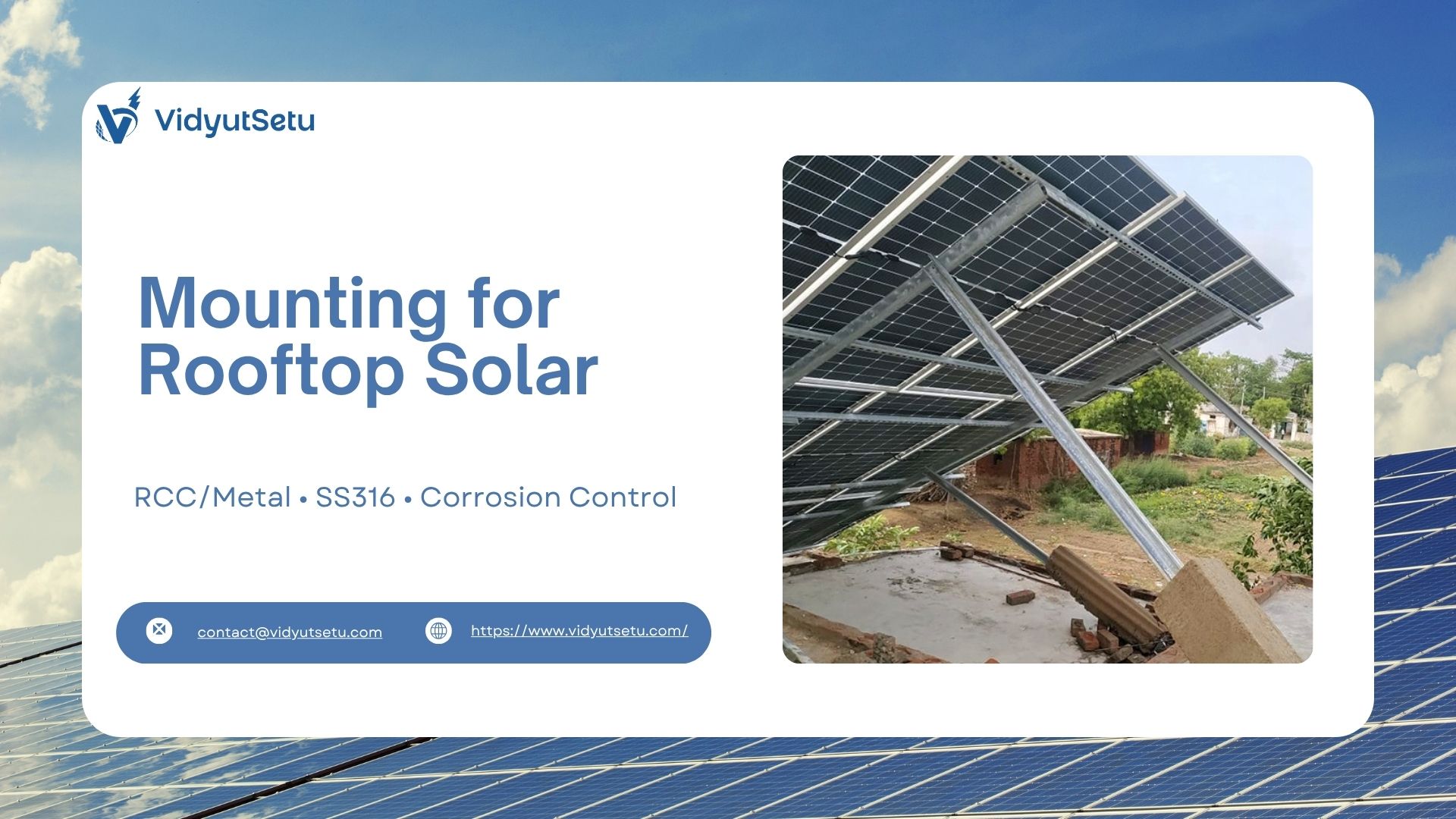
Mounting structure selection for a solar kit depends on three variables, roof type (RCC flat, metal sheet, Mangalore tile), fastener material (SS316 for coastal and industrial zones, hot-dip galvanised for inland dry climates), and wind zone classification per IS 875 Part 3.
A structure that survives monsoon in Pune can fail in its third season on a Konkan coastline. Corrosion and wind load aren’t weather events. They’re design inputs.
The Structure Is Not a Commodity
Walk into the same Bhiwandi wholesale market where cable reels and inverter boxes compete for floor space. In the corner, you’ll find aluminium channel sections and GI angle iron bundled in 6-metre lengths, priced per kilogram, with no wind load rating, no fastener specification, and no corrosion treatment information. Somebody will buy them and install them on a rooftop in Alibag, 11 kilometres from the Arabian Sea.
In three years, that structure will be surface-corroded. In five, the fasteners will be seized. In seven, the modules will be sitting at a tilt angle nobody planned because the mounting rail warped under thermal cycling.
A mounting structure is not a commodity. It’s a civil engineering component with a 25-year service life, operating outdoors, in weather, under sustained mechanical load. The solar BOS specification for structure and fasteners deserves the same rigor as the cable sizing or the earthing system.
It rarely gets it.
Roof Type Determines Everything Downstream
The first structural decision is not about the mounting system. It’s about what the mounting system is attaching to.
RCC Flat Roofs
RCC (reinforced cement concrete) flat roofs are the dominant residential solar roof type across Maharashtra’s urban and semi-urban belt. They’re structurally robust, load-tolerant, and offer installation flexibility, panels can be oriented south at any tilt angle using a ballasted or anchor-fixed structure.
The key consideration is the roof’s load-bearing capacity versus the structure’s dead weight. A standard aluminium mounting structure with 8 panels at 400Wp adds approximately 35 to 45 kg/sqm of additional dead load to the roof surface (including ballast blocks for non-penetrating structures). Most RCC roofs in buildings constructed post-1990 are designed for 150 to 200 kg/sqm live load, this margin is generally comfortable. Pre-1985 construction requires a structural assessment before installation.
For RCC roofs, the options are:
Non-penetrating ballasted structures:
Concrete or rubber block ballast holds the frame in place without drilling into the slab. Fast to install, zero roof waterproofing risk, fully reversible. Wind uplift is managed through ballast weight, which means the ballast calculation must match the site’s wind zone.
Anchor-fixed structures:
Chemical anchors or expansion bolts into the RCC slab provide positive mechanical attachment. Required for high wind zones (Zone IV and V) where ballast alone cannot reliably resist uplift. The anchor point must be into the structural slab, not the screed layer, a distinction that many installation teams get wrong.
Metal Sheet Roofs
Metal sheet roofs, colour-coated steel, GI corrugated, aluminium standing seam, are the standard residential solar roof type in industrial buildings, warehouses, factories, and increasingly in rural residential construction. Solar on commercial buildings with metal sheet roofing is one of the fastest-growing installation segments in Maharashtra.
The critical constraint here is point load. Metal sheet roofing is designed for distributed loads (rain, hail, maintenance personnel), not for concentrated point loads from mounting clamps. Every fastener point on a metal roof is a potential leak point and a potential structural stress concentration.
The correct fastener for corrugated metal sheet is a self-drilling roofing screw with an EPDM (ethylene propylene diene monomer) bonded washer, installed at the crown of the corrugation, not the valley. Valley installation traps water at the fastener penetration point. Crown installation keeps the penetration at the highest point, draining freely.
For standing seam metal roofs, non-penetrating clamps that grip the seam without puncturing the sheet are the only correct solution. Any penetration of a standing seam roof voids the roofing warranty and creates a moisture path that will manifest as an internal ceiling stain before the third monsoon.
Fasteners: SS316 Is Not Overcautious
The fastener conversation in Indian solar installation circles defaults to two positions: “we use stainless steel” (meaning SS304, usually) and “we use galvanised” (meaning zinc-plated, often).
Neither is the right answer for every site. SS316 is.
SS304 stainless steel contains 18% chromium and 8% nickel. SS316 adds 2% molybdenum to that composition. The molybdenum is not a minor additive. It’s what prevents chloride-induced pitting corrosion, the failure mode that destroys fasteners within 3 to 5 years in any environment within 5 kilometres of the coastline, within 2 kilometres of an industrial facility with chlorine or acid emissions, or in any region with saline groundwater.
For the Konkan coast, Navi Mumbai’s industrial belt, and any installation within visible distance of the sea, SS316 is not overcautious. It’s the minimum viable specification.
For inland Maharashtra, Nashik, Aurangabad, Amravati, most of Vidarbha, hot-dip galvanised structures (minimum 85 microns zinc coating per IS 4759) perform reliably for 15 to 20 years and cost significantly less. The galvanising must be hot-dip, not electroplated. Electroplated zinc at 5 to 12 microns is a corrosion finish, not a corrosion solution.
Wind-Safe Layout: The Calculation That Gets Skipped
Every solar kit installation in India sits within one of five wind zones defined by IS 875 Part 3. Wind zone assignment determines the design wind speed, which determines the wind pressure on the panel array, which determines the required structural capacity and fastener pullout force.
Most residential installations in Maharashtra fall in Wind Zone III (design wind speed 44 m/s) or Zone IV (47 m/s). Coastal and island locations often fall in Zone V (50 m/s).
The wind pressure on a solar panel is not simply the pressure on a flat plate at that wind speed. Panels mounted at a tilt angle experience both positive pressure (wind pushing against the front face) and negative pressure, uplift, on the rear. Uplift is typically 1.3 to 1.5 times the positive pressure value for tilt angles between 10 and 30 degrees, because the gap between the panel and the roof creates a venturi effect that amplifies suction.
The perimeter panels in any array face the highest uplift forces. Corner panels face forces 30 to 40% higher than interior panels for the same wind speed. A wind-safe layout accounts for this by:
- Specifying higher fastener density at array edges and corners
- Ensuring edge panels have additional mid-span clamps or enhanced end clamps
- Maintaining minimum setback distance from the roof parapet edge, typically 500mm, to reduce wind channelling effects
The Corrosion Control Checklist
Beyond fastener material, corrosion control in a solar kit mounting system involves three additional considerations:
Dissimilar metal contact:
Aluminium mounting rails in direct contact with GI fasteners create a galvanic couple that accelerates corrosion of both metals at the contact point. Use isolation washers (nylon or EPDM) between dissimilar metals, or specify aluminium fasteners for aluminium rail systems.
Surface treatment on cut ends:
Aluminium channel sections are typically anodised or powder-coated at the mill. Cutting to length on site exposes bare aluminium at the cut end. In coastal installations, apply cold zinc spray or aluminium-compatible sealant to all cut ends before installation.
Standing water elimination:
Any horizontal rail section that allows water pooling creates a corrosion reservoir that works against both the rail and any fastener within the pool. All horizontal rail runs should incorporate drain holes at 600mm intervals, a step that takes 10 minutes per rail with a drill and adds years to structure lifespan.
Why VidyutSetu Specifies Structure Before Site Survey
At VidyutSetu, the mounting structure specification starts with a site assessment question that most EPC teams never ask: what is this roof made of, how old is it, and how far is it from the coast?
The answer to that question determines the fastener spec, the structural system, and the wind load calculation, before a single panel is priced. It’s why our solar BOS documentation includes wind zone classification, soil and roof type, and fastener material as mandatory fields, not optional notes.
We install solar on commercial buildings across Navi Mumbai’s industrial corridor and residential solar roof systems from Alibag to Thane. We’ve seen what five monsoons do to a structure that was specified for a quote rather than a climate.
If your current solar kit proposal includes a mounting structure without a named fastener material, a wind zone reference, or a roof-type-specific installation detail, you’re not looking at a complete system. You’re looking at the beginning of a maintenance problem.
Talk to VidyutSetu. We’ll spec it for the building it’s going on, not the building that’s easiest to quote.