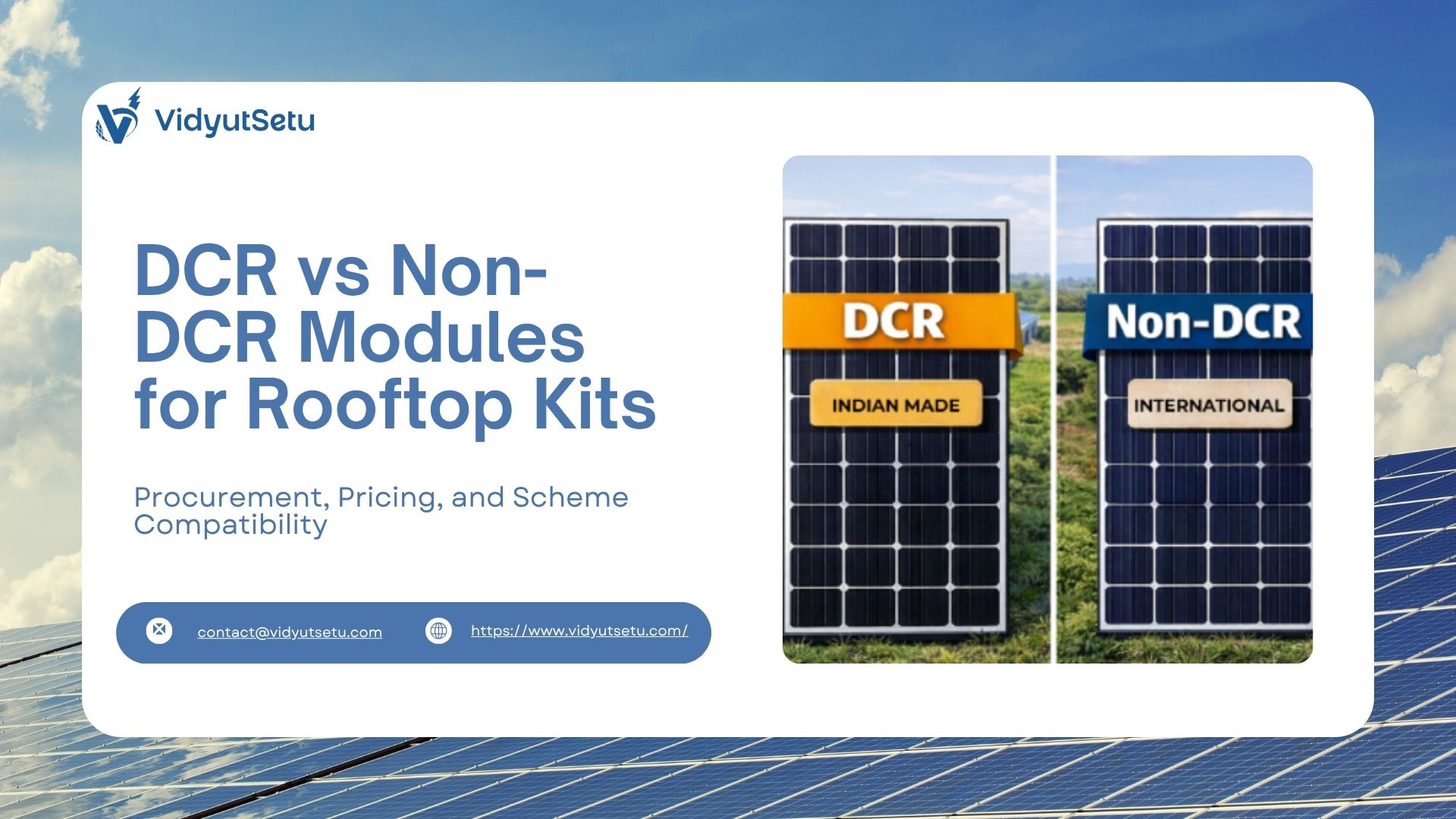
The short answer: DCR modules cost more, take longer to procure, and are non-negotiable for solar subsidy projects. Non-DCR modules are cheaper and faster but lock you out of government schemes entirely. The decision isn’t really about modules. It’s about what the project is for.
DCR (Domestic Content Requirement) solar modules are mandatory for all government-backed solar subsidy projects in India, including PM Suryaghar Yojana and MSKVY. Non-DCR panels cost 8-15% less but disqualify installations from subsidy eligibility.
According to MNRE guidelines, only ALMM-listed DCR modules qualify for residential and agricultural scheme benefits. Choosing wrong at procurement means losing the subsidy entirely, often more than the cost difference.
What DCR and Non-DCR Actually Mean
Most procurement conversations treat DCR vs non-DCR like a checkbox. It isn’t. It’s a procurement philosophy.
DCR stands for Domestic Content Requirement. When a solar kit carries the DCR label, it means the solar cells and modules were manufactured in India, meeting the Ministry of New and Renewable Energy’s criteria for domestic production. The MNRE maintains an Approved List of Models and Manufacturers, commonly called the ALMM list. If a module isn’t on that list, it doesn’t count as DCR, regardless of where it was assembled.
Non-DCR modules are typically imported, often from China, Southeast Asia, or assembled with foreign cells. They’re not inferior in performance terms. In fact, some non-DCR panels have better efficiency ratings at lower price points. But for the purposes of solar subsidy projects, they simply don’t qualify.
The ALMM List Is the Real Gatekeeper
The ALMM list gets updated periodically by MNRE. As of 2025, there are over 60 approved module manufacturers listed under Phase II of the ALMM framework (MNRE, 2025). Not all of them produce consistently. Lead times vary. Batch availability isn’t guaranteed.
This is the detail most procurement teams miss: clearing the DCR requirement isn’t a one-time decision. It requires active vendor monitoring across the project lifecycle.
At VidyutSetu, we’ve tracked ALMM list additions and removals across 18 months of residential solar panel projects. In that time, three manufacturers we initially spec’d were either removed or put under review, creating mid-project substitution challenges for teams that hadn’t built flexibility into their BOM.
How Does This Play Out in Pricing?
DCR modules cost more. That’s the starting point.
The premium ranges from 8% to 15% over comparable non-DCR modules, depending on wattage, manufacturer, and quarterly demand cycles (Bridge to India Solar Market Report, 2024). For a 3 kW residential solar kit, the typical size for PM Suryaghar Yojana, that translates to a cost difference of roughly Rs. 8,000 to Rs. 18,000 on the module component alone.
Sound like a lot? It isn’t, when you put it next to the subsidy.
The Subsidy Math Always Wins
Under PM Suryaghar Yojana, a residential beneficiary gets:
| System Size | Central Subsidy |
| Up to 2 kW | Rs. 30,000 per kW |
| 2 to 3 kW | Rs. 18,000 per kW (for the additional 1 kW) |
| Above 3 kW | Capped at Rs. 78,000 |
A 3 kW system earns Rs. 78,000 in subsidy. The DCR premium on that same system is Rs. 8,000 to Rs. 18,000. The math isn’t close.
The moment you swap to a non-DCR module to save on cost, you forfeit Rs. 78,000 in benefit to save Rs. 15,000 in procurement. That’s not thrift. That’s a procurement error with consequences that reach the end customer.
What Changes in Procurement When You’re Sourcing DCR?
Non-DCR sourcing is transactional. DCR sourcing is relational.
With non-DCR panels, especially for commercial solar panel deployments outside scheme boundaries, you’re essentially buying a commodity. Price, watt-peak rating, delivery window. Done.
DCR procurement adds layers that most small EPC teams underestimate.
Layer 1: Vendor Verification Against Current ALMM List
Manufacturers get added and removed. Always cross-verify your vendor’s ALMM status before locking a purchase order, not when you’re applying for scheme disbursement. We’ve seen projects stall at the disbursement stage because a module that was ALMM-listed at procurement was delisted by approval time.
Layer 2: Documentation Trail
For solar subsidy projects, the documentation burden multiplies with DCR requirements. You’ll need:
- Manufacturer’s ALMM certificate copy
- Module test report (IEC 61215 / IEC 61730 compliance)
- Invoice clearly stating “Made in India” with cell origin
- Form declarations for scheme-specific portals (PM Suryaghar has its own documentation format)
Missing any one of these at the disbursement stage can delay payment by weeks. In Maharashtra, MSEDCL inspection teams have flagged incomplete DCR documentation as the single most common reason for disbursement delays in residential solar panels applications.
Layer 3: Lead Time Planning
DCR module lead times run 3 to 6 weeks on average during peak demand periods (October to March, aligned with financial year-end project pushes). Non-DCR can often be sourced in 1 to 2 weeks. For large-scale solar subsidy projects with disbursement deadlines, this 4-week gap matters.
Build the lead time into your project schedule. Don’t discover it after signing the installation commitment with the client.
Which Schemes Require DCR, and Which Don’t?
This is the clearest way to frame the decision.
| Scheme / Project Type | DCR Required? |
| PM Suryaghar Yojana (residential) | Yes — mandatory |
| MSKVY (agricultural solar feeders) | Yes — mandatory |
| KUSUM Component A & B | Yes — mandatory |
| Commercial solar panel (private, no subsidy) | No |
| Industrial EPC (open market) | No |
| Export-linked or ISTS-connected projects | Depends on tender |
If there’s a government subsidy attached, assume DCR is required unless the tender document explicitly states otherwise. Don’t assume. Read the scheme guidelines.
For private commercial solar panel installations, factories, warehouses, offices, where the client isn’t claiming any subsidy, non-DCR modules are a valid choice. The performance parameters are often equal or better. The procurement lead time is shorter. And the client gets a faster return on investment through lower upfront cost.
The Mistake EPC Teams Make Most Often
They make the module decision too late.
By the time a site survey is done, a client has signed, and an installation date is committed, the procurement window for DCR modules is already tight. If the project is a solar subsidy project, and the team hasn’t started vendor verification and module booking within the first week of client onboarding, they’re already behind.
The other mistake is mixing DCR and non-DCR within a single system to cut costs. This is a hard no for any scheme-eligible installation. Partial DCR compliance doesn’t equal full DCR compliance. DISCOM inspection teams are trained to check module serial numbers against ALMM records. One non-DCR panel in a 10-panel array can disqualify the entire system from subsidy.
The DCR requirement isn’t just a government formality. It’s a forcing function that builds Indian manufacturing capacity. Every solar kit installed under a DCR mandate is, in aggregate, a demand signal to domestic manufacturers. EPC teams that understand this don’t resent the requirement, they plan around it as a fixed constraint, the way a builder plans around a setback line.
A Practical Decision Framework
Before specifying modules for any project, answer three questions:
- Is any government subsidy or scheme disbursement involved?
If yes, DCR is mandatory. Go to ALMM list. Verify vendor. Book early.
- What’s the client’s timeline priority vs cost priority?
If timeline is critical and no subsidy is involved, non-DCR may serve better. If cost savings matter and the client qualifies for a scheme, DCR with subsidy always wins on total cost.
- Is the project above 10 kW?
Larger commercial solar panel installations often fall outside residential scheme caps. Check whether RDSS, KUSUM, or other scheme components apply before defaulting to non-DCR on size assumption.
What This Means Going Forward
Solar policy in India is moving faster than most procurement teams can track. The ALMM framework is getting stricter, not looser. The government’s push to build domestic manufacturing capacity means DCR requirements are likely to expand to more project categories, not fewer.
Teams that treat DCR compliance as an afterthought will keep losing projects at the disbursement stage. Teams that build DCR sourcing into their standard operating procedure will close solar subsidy projects faster, cleaner, and with fewer client escalations.
The module choice is upstream of everything else: subsidy eligibility, documentation, lead time, and client experience. Get it right at the start.
That’s not procurement advice. That’s project design.