
Why the cheapest solar quote is usually the most expensive decision your business will make.
When businesses evaluate rooftop solar in India, the first instinct is to compare prices. Three vendors submit quotations for a 100-kW system. One comes in at ₹38 lakhs. Another at ₹42 lakhs. The lowest bid looks like the obvious winner.
But installing rooftop solar for your business in India is not a one-time purchase it is a 25-year infrastructure decision. And the cheapest quote is almost always the one that delivers the worst long-term returns.
“The real cost of solar isn’t what you pay today. It’s what the system fails to earn over the next 25 years.”
Why Price Alone Is the Wrong Way to Compare Rooftop Solar Quotes
Two quotes for the same capacity say, 100 kW can look almost identical on paper but reflect vastly different realities in components, engineering, and long-term performance.
| What You’re Actually Comparing | ₹38 Lakh Quote | ₹42 Lakh Quote |
| Solar panel grade | Tier 2 / unbranded | Tier 1 / bankable brand |
| Inverter efficiency | ≤95% | 97–98%+ |
| System engineering | Generic layout | Site-specific design |
| Shadow / tilt analysis | Often skipped | Detailed assessment |
| Post-installation service | Minimal / ad hoc | AMC & monitoring |
| Warranty reliability | Vendor may not survive | Backed by manufacturer |
A price difference of ₹4 lakhs upfront sounds significant. But look at what it means across 25 years.
You Save ₹4 Lakh Today. You Lose ₹40 Lakh Over 25 Years.
Imagine two businesses. Both install a 100 kW solar system on their rooftop. Both pay roughly the same electricity bill today.
Business A spent ₹42 lakhs and got a properly designed system with quality panels.
Business B spent ₹38 lakhs and went with the cheaper vendor.
Same rooftop. Same city. Same sunlight.
But every single month, Business B’s system produces less electricity. Not dramatically less just quietly, consistently less.
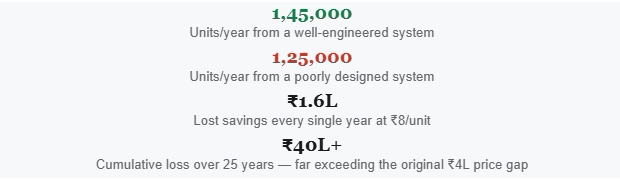
By end of year one, Business B has already lost ₹1.6 lakh in electricity savings it should have earned.
By year 5, that’s ₹8 lakh gone.
By year 25 the full life of the system Business B has lost over ₹40 lakh.
That ₹4 lakh “saving” cost them ten times more.
Why Component Quality Matters More Than You Think
A solar plant performs only as well as its weakest component. Inferior panels, inverters, cables, and connectors introduce compounding problems that grow worse over time not better.
Common consequences of low-quality components
- Reduced energy generation from day one due to lower panel efficiency
- Accelerated degradation cheap panels lose 1–2% more efficiency per year
- Frequent inverter failures causing costly downtime and production loss
- Fire risk from sub-standard DC cables and junction boxes
- Warranty claims that go unanswered when small vendors shut down
- Higher Operations & Maintenance costs throughout the asset’s life
Why a Good Solar System for Your Business in India Starts with Engineering
Even the best solar panels cannot compensate for poor system design. This is the mistake that cost-focused buyers make most often: assuming that panel brand is the only variable that matters.
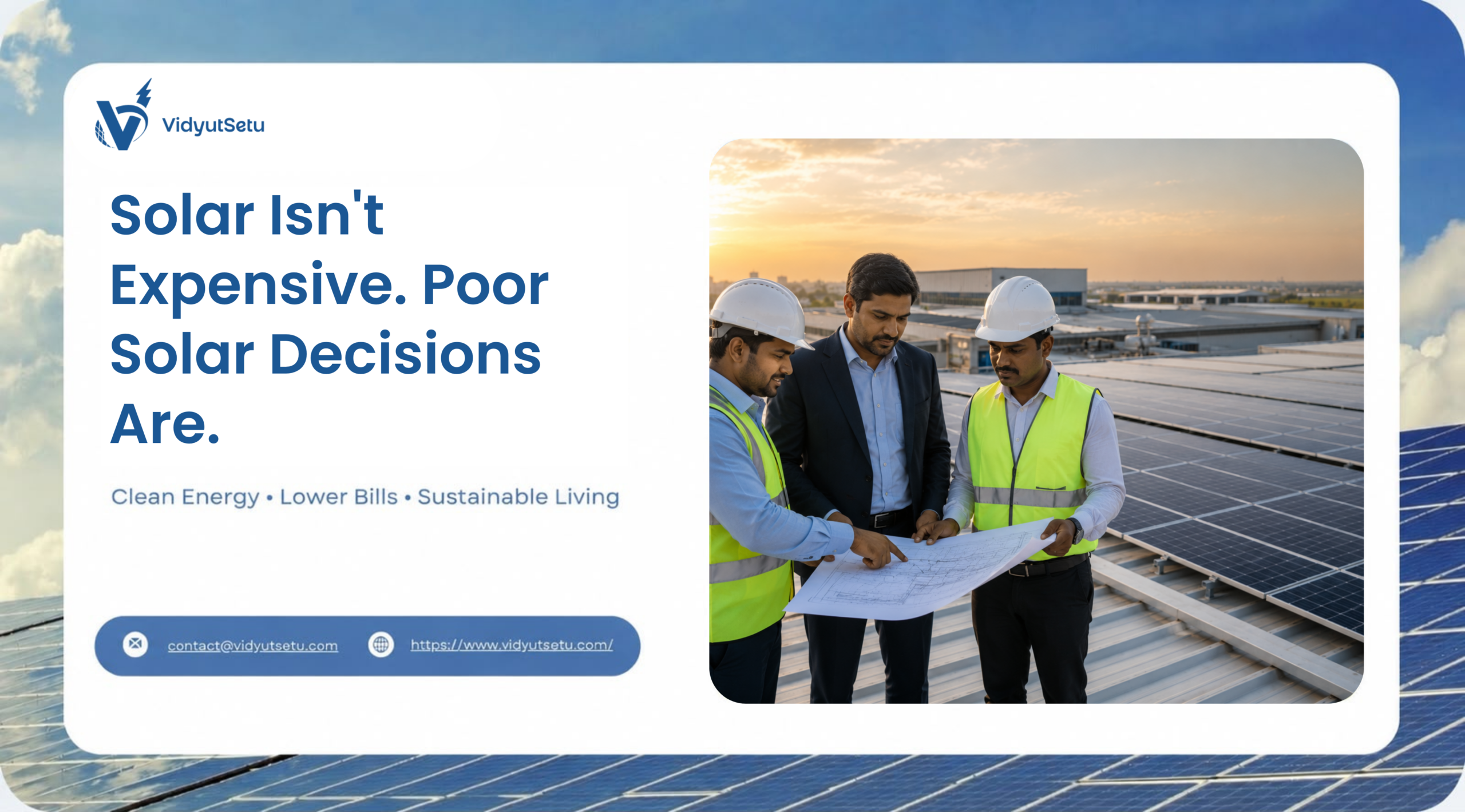
Proper solar engineering includes a detailed load analysis, inverter sizing, shadow assessment using simulation software, panel tilt and azimuth optimisation, and string configuration designed for the specific site. A difference in annual generation of 15–20% between a well-engineered and a poorly designed system of the same capacity is not unusual.
For a commercial installation in India, that gap can mean the difference between a 4-year payback and a 6-year payback a 2-year delay in realizing returns on an investment that will run for 25 years.
What to Ask Before You Install Rooftop Solar for Your Business in India
The right question when reviewing solar proposals is not “Which quote is cheapest?” It is: “Which system will deliver the highest returns across its 25-year life?”
What to ask every solar vendor before signing
- Expected annual generation (in units) – modelled from site data, not generic estimates
- Panel efficiency and degradation warranty – linear performance warranty over 25 years
- Inverter brand and efficiency rating – MNRE-approved, with local service support
- Shadow analysis report – especially if your roof has AC units, water tanks, or parapets
- DC and AC cable specifications – undersized cabling is a common cost-cutting point
- Post-installation monitoring – remote fault detection catches losses early
- Annual Maintenance Contract terms – who is responsible, and for how long?
- Vendor financial stability – will they still exist in year 10 to honour warranties?
Frequently Asked Questions
Why is the cheapest solar quote usually the most expensive in the long run?
Cheaper quotes typically reflect lower-quality panels, inferior inverters, and generic system design. These reduce energy generation, increase downtime, and raise maintenance costs often costing far more over 25 years than the original savings.
What should a business compare when evaluating solar proposals?
Beyond the total price, evaluate panel brand and efficiency, inverter quality, projected annual generation, shadow analysis methodology, warranty terms, and post-installation service support. Lifecycle cost not project cost is the correct metric.
How much can poor solar design cost a commercial business?
A poorly designed 100 kW system may generate 20,000 fewer units per year than a well-engineered one. At ₹8 per unit, that’s ₹1.6 lakh lost annually over ₹40 lakh across 25 years, often far exceeding the original price difference between vendors.
What is a good payback period for commercial rooftop solar in India?
For a well-designed commercial system in India, a payback period of 3–5 years is achievable depending on tariff rates, location, and system size. Poorly designed systems often push this to 6–8 years or more.
How do I verify solar panel quality before buying?
Look for panels from Tier 1 manufacturers (Bloomberg New Energy Finance list), confirm MNRE approval, check for IEC 61215 and IEC 61730 certifications, and ask for the linear degradation warranty a credible manufacturer guarantees at least 80% output at year 25.
Solar energy is one of the smartest long-term investments a business can make but only when it is done right. The companies that regret solar almost always chose the cheapest quote. The ones who see 25 years of reliable returns chose the best-engineered system. If you are evaluating rooftop solar for your business in India, the only question worth asking is not “which quote is cheapest” it is “which system will deliver the most over the next 25 years.” Solar isn’t expensive. Poor solar decisions are.
Ready to evaluate your solar investment properly?
Vidyutsetu begins every project with detailed site assessment, engineering analysis, and careful component selection so your system delivers maximum value over its full 25-year life.
Get a lifecycle-focused solar assessment →