
Rising electricity bills affect apartment owners across Maharashtra every year. If you live in a housing society in Navi Mumbai, Mumbai, Thane, Pune, or Raigad, you may already wonder whether solar panels are a realistic option for you. The answer is yes and this guide explains everything you need to know about installing solar panels in a housing society in Maharashtra, from space requirements and society permission to the PM Surya Ghar subsidy and the step-by-step installation process.
Quick Reference: Solar in a Housing Society at a Glance
| Parameter | Details |
|---|---|
| Space needed (6 panels) | ~195 sq ft (terrace or balcony) |
| Society permission | Required – written application |
| PM Surya Ghar subsidy | Up to ₹78,000 for eligible consumers |
| Subsidy scheme validity | Expected until 31 March 2027 |
| Panel product warranty | Up to 12 years |
| Panel performance warranty | 25+ years |
| Inverter warranty | Up to 8 years |
| Maintenance cost | Low – mostly periodic cleaning |
1. Solar Panels in Maharashtra: How Much Space Does Your Apartment or Society Need?
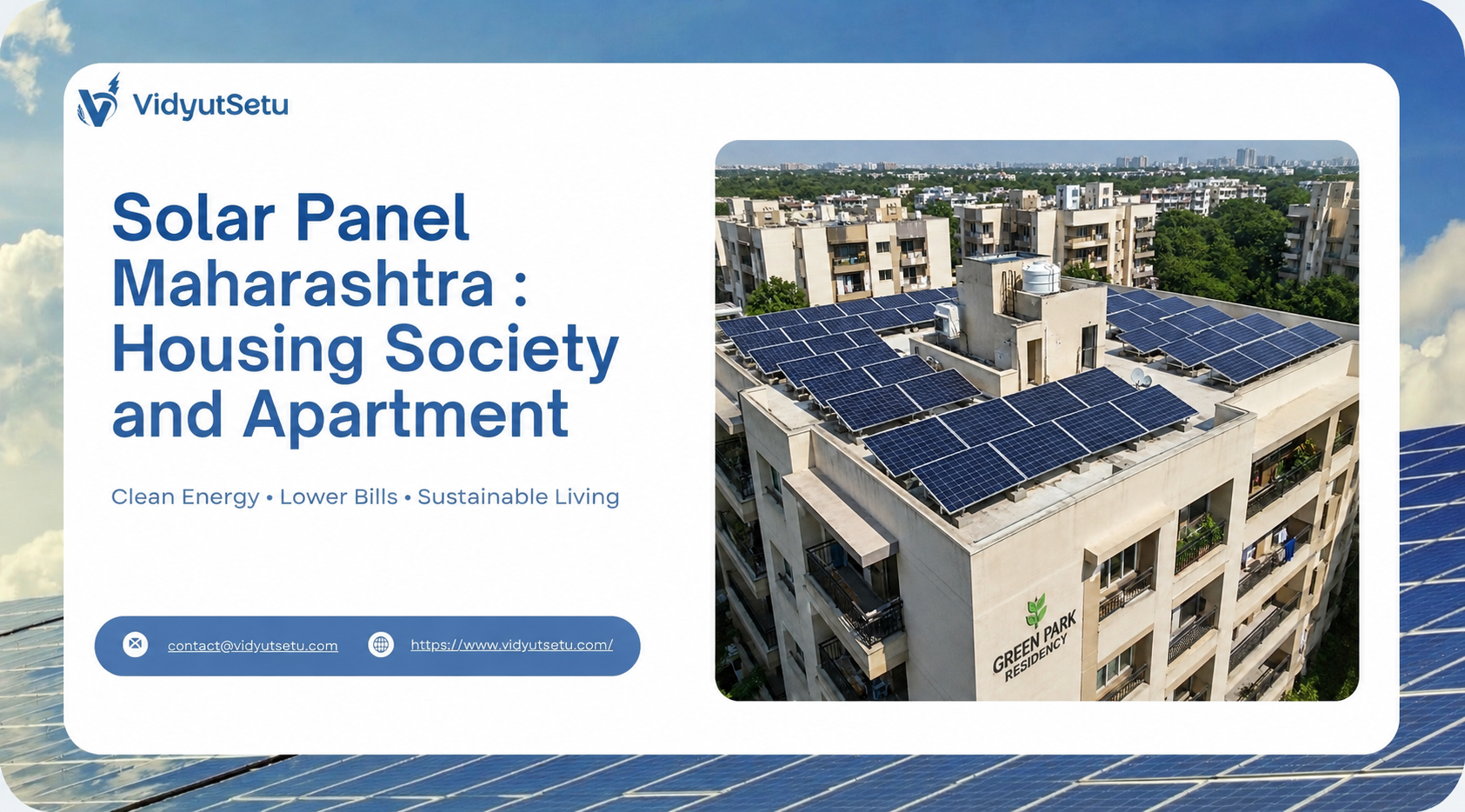
First and foremost, space is the the first practical question for any housing society resident considering solar panels in Maharashtra. Unlike independent homes with dedicated rooftops, apartment owners typically have two options.
Option A: Balcony Installation
If your balcony receives direct sunlight for at least 7 hours per day and has adequate load-bearing capacity, a small solar system works well here. This option suits powering fans, lights, or a refrigerator.
Option B: Shared Society Terrace
The terrace is the preferred option for solar panels in a housing society. It receives unobstructed sunlight, accommodates more panels, and allows for the optimal south-facing tilt angle for maximum energy generation across Maharashtra.
How Much Space Do You Need?
A standard solar panel measures approximately 4 ft × 8 ft (32 sq ft per panel). Therefore, a minimum viable residential system needs at least 6 panels, so you need roughly 195–210 sq ft of clear, shadow-free terrace space. In addition, you must allow clearance around panels for maintenance walkways.
| 📊 Real-World Example: A 2BHK flat in Navi Mumbai consuming ~250 units/month typically needs a 2–3 kW solar system (6–9 panels), requiring roughly 200–290 sq ft of terrace space. At Maharashtra’s average of 4.5–5 peak sun hours per day, this generates 240–360 units per month covering most or all of a typical apartment’s electricity needs. |
2. Do You Need Permission from Your Housing Society?
Yes, and getting it in writing protects you. Even when your installation is on your own balcony, solar cables, earthing pits, and wiring often pass through common areas. Society approval protects both you and the society from future disputes.
Here is why approval is generally necessary:
- Solar cables often route through common passages or stairwells
- Installers typically place inverters near common electrical rooms
- Earthing pits sit in the common ground area
- Terrace access for installation and maintenance involves common property
- Net meter wiring connects through the society’s main electrical panel
How to Apply for Society Permission
Submit a formal written application to your Managing Committee. Include the following:
- Written application stating your intent, system size, and area required
- Vendor credentials and safety certifications
- Written approval request for terrace or common area access
3. Can a Housing Society Legally Refuse Your Solar Request?
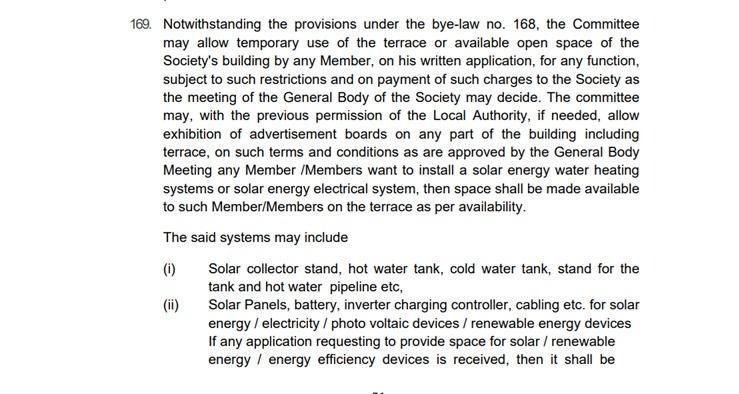
Under the Maharashtra Cooperative Societies (MCS) Act and the provisions of bylaws,a housing societies cannot arbitrarily deny a resident’s request to install a solar system for personal residential use, provided the installation meets technical standards and a proper written application is submitted.
Please refer bylaw no 169 of the MCS act for the provisions stated.
Societies can set reasonable conditions such as:
- Requiring restoration of the terrace if the resident vacates
- Mandating only licensed electricians perform the work
- Specifying time windows for installation to minimise disruption
- Requesting a structural load certificate from the vendor
| 💡 Practical Tip:Most Maharashtra societies readily approve solar requests. Frame your application as a community benefit — rooftop solar reduces dependence on MSEDCL grid power and can be expanded to power common area lighting, benefiting all residents. |
4. PM Surya Ghar Yojana – The Subsidy Every Apartment Owner Must Know
The PM Surya Ghar Muft Bijli Yojana is the Central Government’s flagship rooftop solar scheme. It is also the most significant financial incentive available to residential solar consumers in India, including apartment owners installing solar panels in a housing society in Maharashtra.
How Much Subsidy Can You Get?
Eligible residential consumers receive subsidies of up to ₹78,000, depending on system size. The scheme is currently active and the government expects it to continue until 31 March 2027.
Key Eligibility Conditions
- System must be installed by a PM Surya Ghar empanelled vendor
- Connection must be under a residential electricity tariff (MSEDCL)
- Installation on your own premises (balcony or terrace with society NOC)
- Net metering must be applied for through MSEDCL
- Only one subsidy per household connection is permitted
To Get more info on this click here: PM Surya Ghar Mufti Yojana
| ⚠️ Important:The subsidy is credited directly to your bank account after MSEDCL inspection and net meter commissioning. Incomplete applications are the leading cause of delays. VidyutSetu manages the full PM Surya Ghar subsidy documentation process for all clients. |
5. What Happens After Society Approval? The Installation Process
Once you have society approval and you select a vendor, the process moves in a clear sequence:
- Site Survey & Feasibility Assessment – The vendor assesses terrace space, panel orientation, shading, and your electrical load requirements.
- System Design – A customized system is designed based on your monthly units consumed, available space, and budget.
- Mounting Structure Installation – GI or aluminum structures are fixed to the terrace. For RCC terraces, most designs do not require drilling into the slab.
- Panel & Inverter Installation – Panels are wired in series/parallel strings. The installer then connects the inverter (on-grid or hybrid).
- Earthing & SPD – The team installs earthing pits and Surge Protection Devices are installed for safety and MSEDCL compliance.
- Net Meter Application – The vendor files the net metering application with MSEDCL on your behalf, so excess units are credited back to your bill.
- Testing, Commissioning & Subsidy Filing – Finally, the team completes QA checks (polarity test, IR test, earth resistance), commissions the system, and submits the PM Surya Ghar subsidy application.
6. What Is the Cost of Solar Installation in a Housing Society?
Cost varies by project. Apartment installations often carry additional costs compared to independent homes because of:
- Longer DC and AC cable runs from the terrace to your floor or meter
- Conduit routing through common areas
- Different electrical phases (single-phase vs three-phase)
- Additional safety equipment that MSEDCL requires for net-metered systems
As a general reference, a 3 kW on-grid rooftop solar system in Maharashtra costs between ₹1.8 lakh and ₹2.4 lakh before subsidy. After the PM Surya Ghar subsidy, the effective cost drops significantly. A site inspection is necessary for an accurate quote.
7. Maintenance: What Does It Actually Cost After Installation?
Solar panels have no moving or mechanical parts, which means ongoing maintenance costs are extremely low.
Routine Maintenance Includes:
- Periodic cleaning of panels dust and bird droppings reduce output by 15–25% when left uncleaned
- Visual inspection of cables, junction boxes, and mounting structures typically twice a year
- Inverter parameter checks via the monitoring app
- Annual earth resistance testing
In general, most residential systems need one professional cleaning and inspection per quarter. You can manage the rest through the inverter’s mobile monitoring app.
8. Warranty Coverage: What Is Protected and for How Long?
Solar systems are designed for 25+ year lifespans. Here is what standard warranties cover:
- Solar Panels Product Warranty: Up to 12 years (covers manufacturing defects)
- Solar Panels Performance Warranty: Minimum 25 years (guarantees >80% output at year 25)
- Solar Inverter: Up to 8 years
- Mounting Structure: Typically, 5–10 years against corrosion
Always obtain warranty documents in writing at the time of installation.
9. Key Benefits of Solar Panels for Housing Society Residents
Overall, installing solar panels in Maharashtra delivers several measurable advantages:
- Lower electricity bills: Generate your own power and directly offset MSEDCL consumption.
- Government subsidy: PM Surya Ghar Yojana offers up to ₹78,000 for eligible consumers.
- Protection against tariff hikes: Maharashtra electricity tariffs rise consistently. Solar locks in your generation cost for 25 years.
- Increased property value: Solar-equipped flats are more energy-efficient and carry tangible resale advantages.
- Net metering income: Excess units exported to the MSEDCL grid reduce your next bill.
- Environmental impact: A 3 kW solar system prevents approximately 3–4 tonnes of CO₂ per year.
FAQ Section
Without society approval you cannot access the common terrace, and cable routing through common areas is also not possible. The best approach is to submit a proper written application and, if needed, raise the matter at a General Body Meeting where a resolution can be passed to approve solar adoption.
For approval at a General Body Meeting or Annual General Meeting, place a written application to the Managing Committee at least one month in advance. The committee can discuss and approve it at a monthly Managing Committee Meeting, or place it as an agenda item for the GBM or AGM. Both the Managing Committee and the GBM/AGM have the authority to approve the application.
Yes. Apartment owners with an individual MSEDCL residential connection are eligible, provided the system is installed by a PM Surya Ghar empanelled vendor and net metering is applied for.
Moreover, this creates an excellent opportunity for a group installation on the society terrace. Multiple owners can reduce per-unit costs through bulk purchasing and apply for individual subsidies for each residential connection. Societies in Navi Mumbai and Pune have done this successfully.
No. A properly designed on-grid or hybrid solar system connects at your Meter and does not require changes to your existing internal wiring.
Generally, physical installation takes 3–5 days. Net meter approval from MSEDCL can take 2–6 weeks. Subsidy credit to your bank account follows after the MSEDCL inspection and commissioning.
Ready to Install Solar Panels in Your Housing Society?
VIDYUTSETU specializes in rooftop solar installations for housing societies across Maharashtra — including Navi Mumbai, Mumbai, Thane, Pune, Nashik, Raigad, and the Konkan region. Our team handles everything from the initial site survey and society approval guidance to PM Surya Ghar subsidy filing, MSEDCL net meter applications, and post-commissioning support.
Contact VIDYUTSETU today at +91 7506392320 or visit www.vidyutsetu.com to get a free 3D site assessment and savings estimate for your apartment.
— Published by VidyutSetu | Solar EPC & Rooftop Solar Specialists, Maharashtra | vidyutsetu.com