
If you are running a factory in India today, you know the drill. Every time the electricity department announces a tariff hike, your profit margins take a hit. For an industrialist, power is not just a utility; it is one of the biggest raw materials. In 2026, relying solely on the grid is like trying to fill a bucket with a hole in it.
The good news? Solar energy has moved from being a “fancy green project” to a hardcore financial strategy. But when you start looking for a commercial solar panel setup, the numbers can get confusing. Is the cheapest quote the best? Why does one vendor charge more for the same kilowatt capacity?
Let’s cut through the noise. As someone who looks at these systems every day, I am going to break down the actual costs of panels, inverters, and that often-ignored hero called the solar BOS. This is not a generic brochure; this is the reality of the Indian industrial solar market right now.
The Big Question: What is the Total Investment?
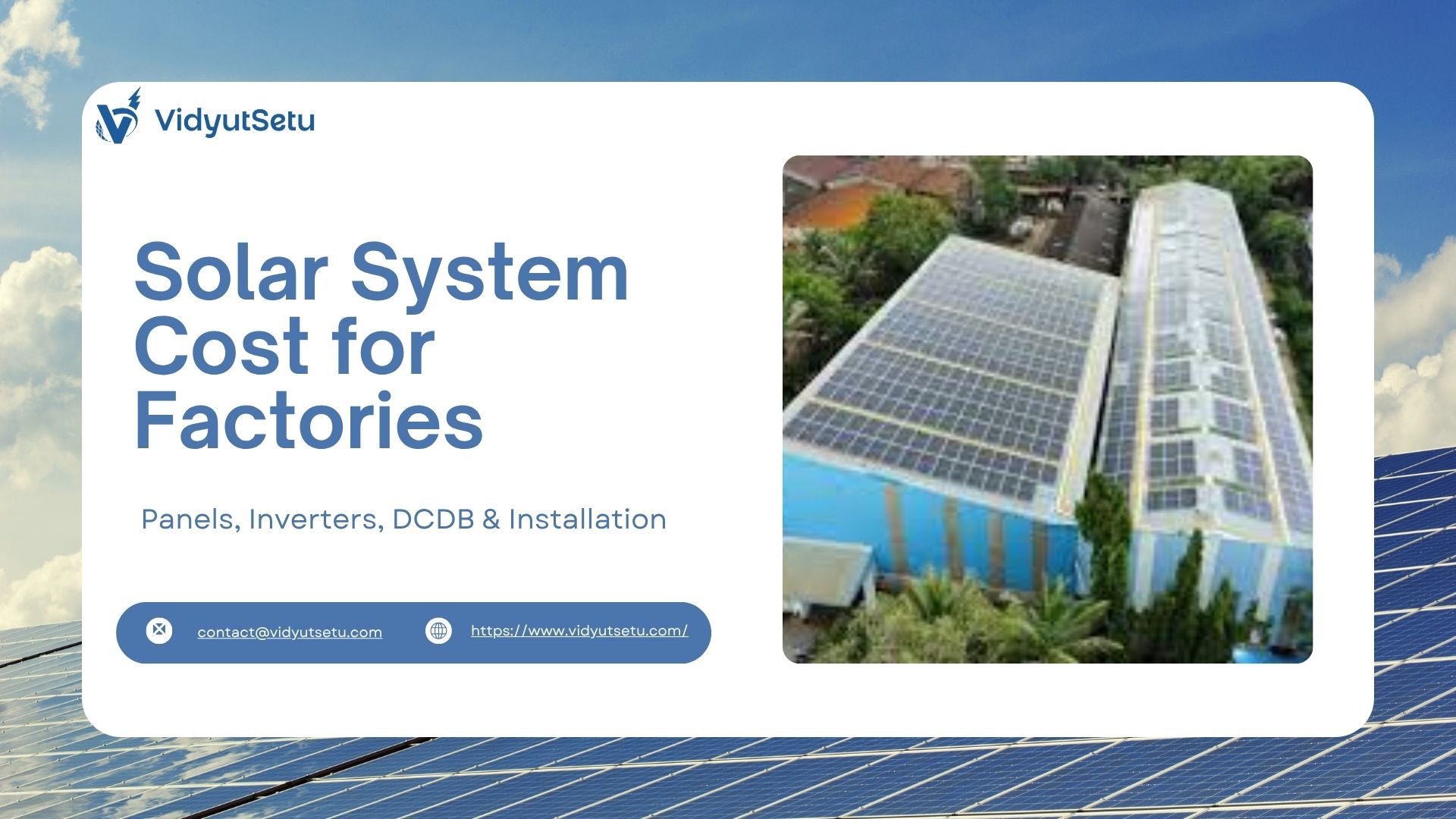
In 2026, the price for an industrial solar plant in India generally falls between ₹35,000 and ₹50,000 per kW. If you are a medium-sized factory looking at a 100 kW system, you are likely looking at an investment of ₹40 lakh to ₹50 lakh.
Why the range? Because a factory roof in a windy coastal area like Gujarat needs a different structure than a flat roof in an industrial park in Noida.
Here is how your money is divided:
- Solar Panels: 55% to 60%
- Inverters: 15% to 20%
- Structure and Solar BOS: 15%
- Installation and Permissions: 5% to 10%
1. The Panels: Your Energy Producers
Price per watt is not the only thing to consider when selecting a commercial solar panel. By the year 2026 the industry is shifted nearly to Mono-PERC and TOPCon technology.
When you have a small roof size, you have a desire to have the high-efficiency panels (22 percent efficiency or higher). Why? Since you can achieve 500 kW on a roof where you could only achieve 400 kW previously, your cost per unit of electricity in 25 years reduces greatly.
Another one to watch is Bifacial. These receive the light on either side. These are capable of providing you with 10 percent more power at minimal additional expense in case you have a white-painted roof or a ground-mounted system with a reflective environment. That 10 percent in the industrial solar world is one year of payback difference between a 3 year payback and a 4 year payback.
2. The Brain of the System: Ongrid Solar Inverters
In the case of most Indian factories, ongrid solar inverters are the most commonly used. You do not require any batteries since you are already an extension of the grid. The inverter uses the DC power on your roof and converts it to AC power to power your CNC machines, compressors and your lights.
These inverters are so intelligent in the year 2026. We now look for features like:
- High Efficiency (98% or above): In order not to waste power in the conversion.
- Remote Monitoring: It should also allow you to know the degree to which your factory is producing power through your phone.
- AFCI (Arc Fault Circuit Interrupter): It is a safety requirement. It identifies small sparks and triggers the shutdown of the system before it can ignite a fire.
A factory owner can make the biggest mistake in that he/ she buys a cheap inverter. Should the inverter malfunction, then all those lakh plus investments that you had invested in would be nothing more than blue glass lying on your roof and doing nothing with it.
3. The DCDB: Your Safety Guard
The DC Distribution Box (DCDB) is the “security guard” of your solar plant. It sits between the panels and the inverter. It contains fuses and Surge Protection Devices (SPDs).
In India, we deal with a lot of lightning and sudden voltage spikes. If a spike hits your panels, the DCDB sacrifices itself to save your expensive inverter. Never let a contractor cut costs here by using “local” components. You want Tier-1 protection because your factory’s safety is on the line.
4. The Solar BOS: The “Glue” That Holds It Together
Most people focus on panels, but the solar BOS (Balance of System) is where the long-term winners are separated from the losers. This includes your mounting structures, cables, and earthing.
- Mounting Structure: It must be Hot-Dip Galvanized. Why? Because Indian monsoons are harsh. If your structure starts rusting in 3 years, your panels might fly off in a storm.
- Cables: Use only UV-protected solar DC cables. Standard electrical wires will crack under the sun in less than two years.
- Earthing and Lightning Arrestors: This is non-negotiable. One lightning strike can wipe out your entire system if the earthing is not done professionally.
The Payback: When Do You Get Your Money Back?
This is the part factory owners love. In 2026, the ROI (Return on Investment) for industrial solar is fantastic.
- Accelerated Depreciation: You can claim tax benefits that effectively reduce your system cost by another 10% to 15% in the first few years.
- Zero Bill Months: During peak summer, many factories find their solar generation covers nearly 70% to 80% of their daytime load.
- Payback Period: Usually, a well-designed system pays for itself in 3 to 4 years. Since the system lasts 25 years, you get 21 years of nearly free electricity.
Don’t Just Buy a System, Buy a Partnership
Installing solar on a factory is not a “set it and forget it” job. You need a partner who understands that if your solar system stops working, it affects your production.
This is where VidyutSetu steps in.
Based in Navi Mumbai, we specialize in helping Indian industries make the switch without the headache. We are a full-service EPC company, which means we don’t just drop boxes at your gate. We handle the site survey, the heavy-duty engineering, the government “Net Metering” paperwork, and the final commissioning.
Why choose VidyutSetu for your factory?
- Industrial Grade Engineering: We don’t use residential-grade parts for factories. We use heavy-duty solar BOS components designed for high-heat industrial environments.
- Transparency: We break down every cost. You will know exactly which commercial solar panel brand you are getting and why we chose a specific ongrid solar inverter for your load.
- Financing Help: We know CAPEX can be a hurdle. We work with banks like SBI and HDFC to help you get solar loans so you can pay for the system using the money you save on electricity bills.
- 24/7 Monitoring: We don’t just install and leave. Our team monitors your system performance and provides regular maintenance to ensure those panels stay clean and productive.
If you are tired of high electricity bills and want to turn your factory roof into a profit-making asset, let’s talk.