
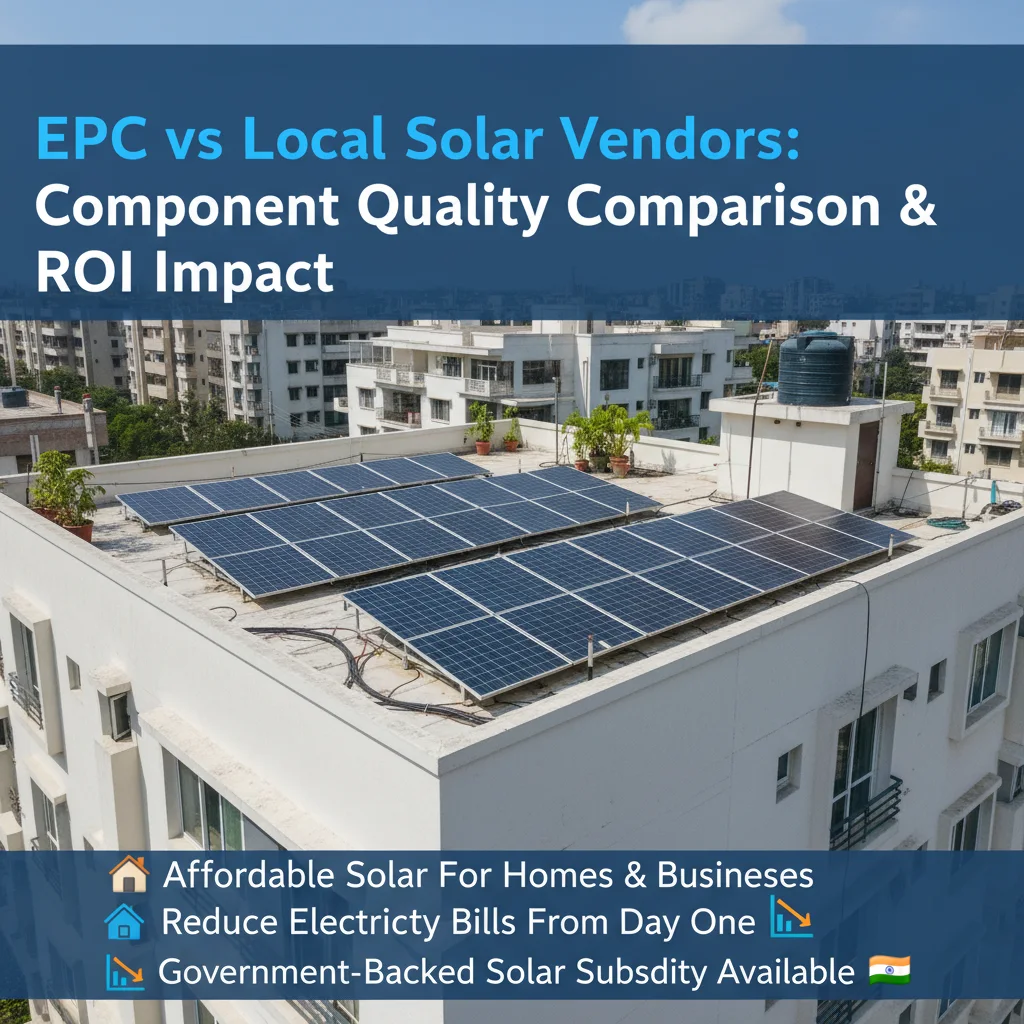
Should you choose to install a solar system, one of the most significant choices you would have is this one: Do you choose a professional EPC company or a local solar vendor in your city or town?
Local vendors might appear to be less expensive and more amiable to communicate with. However, in the case of commercial solar power, long-term savings, and quality of components, the distinction between the two is extremely evident.
In this article we are going to describe what EPC companies really perform, the difference between them and local installers, and how your decision may influence the quality of such components as high efficiency solar panels and solar BOS (balance of system). But most importantly we will examine how all this will affect your ROI (return on investment).
And lastly, we will present to you an affiliate EPC company, VidyutSetu, that is assisting homes and businesses in India to put solar in the right way.
What Is an EPC Company in Solar?
EPC is an acronym, which means Engineering, Procurement, and Construction. The following companies handle the complete solar project:
- Engineering: They are concerned with the design of the correct size of the system, layout, angle, and electrical planning.
- Procurement: They are purchasing high quality parts, solar panels, inverters, cables, structures and they are frequently procuring the best brands directly.
- Construction: They deal with professional installation, testing and grid connection.
The EPC companies operate in proper documentation, safety requirements, and guarantees. They also tend to have a well-trained technical department.
What Do Local Solar Vendors Do?
Local vendors usually focus on selling and installing solar panels in a particular area. Some are electricians or small businesses who have added solar services recently.
They may not do detailed engineering. Many of them buy panels and parts from distributors without verifying long-term performance. They might skip site surveys or important electrical safety steps.
Component Quality: EPC vs Local Vendors
Let’s compare what you usually get from both options.
Solar Panels
EPC: Uses high-efficiency solar panels from reputable manufacturers such as Tata Power Solar, Adani Solar, Waaree Energies, Vikram Solar, Loom Solar, and other Tier-1 brands that consistently deliver strong performance and reliability. These panels typically achieve competitive efficiency levels and long-term durability suited for residential and commercial rooftop installations.
Local Vendor: May use low-cost panels with lower efficiency (16–18%), or older stock. Often cannot explain the brand or panel specs clearly.
Inverters
EPC: Selects inverters after proper load and system analysis, choosing high-quality string, hybrid, or microinverters from trusted brands such as Sungrow, SolarEdge, Enphase, GoodWe, Solis, SMA, Growatt, Delta, and Luminous to ensure efficiency, reliability, and long-term performance for residential and commercial systems. These brands are widely recognised for strong performance and technology in the Indian solar market.
Local Vendor: May use whatever is available at low cost. Mismatched inverter size is common, leading to poor performance and risk of failure.
Solar BOS (Balance of System)
BOS includes cables, mounting structure, junction boxes, protection devices, etc.
EPC: Uses proper gauge DC/AC cables, GI with wind resistance, branded MC4 connectors, MCBs, surge protectors, earthing, all as per BIS standards.
Local Vendor: Often skips safety devices, uses poor cables, and weak structures. This leads to breakdowns, fire risk, and more maintenance costs.
Installation Standards
EPC companies follow a checklist for:
- Shadow analysis
- Cable routing and protection
- Wind speed testing for structures
- Grid synchronization
- App-based performance monitoring
- Government approvals (especially for commercial solar panel systems)
Local vendors often rush installation without proper planning. This leads to:
- Lower solar generation
- No online monitoring
- Water leakage from poor mounting
- Grid connection delays
- No subsidy support due to lack of registration
Warranty & Service
EPC:
- Provides 25-year panel warranty, 5–10 years inverter warranty
- Includes 5 years service support or AMC
- Gives you documentation, warranty cards, and service numbers
- Tracks performance and helps file complaints if needed
Local Vendor:
- May give only panel brand warranty, no inverter or service warranty
- No guarantee for on-site help
- Disappears if there’s a problem after 6 months
ROI (Return on Investment): Which One Wins?
Here’s what many people don’t realise: Cheaper installation doesn’t always mean better savings.
| Parameter | EPC | Local Vendor |
| Panel Quality | High-efficiency, branded | Medium/low quality |
| Power Generation | More kWh/day | 10–30% less |
| Downtime Risk | Very low | Higher |
| Repair Cost | Covered under service | You pay extra |
| Lifespan | 25+ years | May fail in 7–10 years |
| ROI Timeline | 3–5 years | 5–8 years or more |
If a local vendor’s panel saves you ₹20,000 upfront but makes you lose ₹10,000/year in electricity savings, that’s not a smart deal.
Especially in commercial solar power projects, such as factories, offices, and warehouses, reliable performance, uptime, and ROI clarity are critical. One bad inverter can cost lakhs in power loss.
Real-World Example
Let’s say a school wants a 10kW commercial solar panel system.
- Local Vendor: Offers installation at ₹4.5 lakh, but uses basic 18% panels, no monitoring, weak structure.
Power generation: 35 units/day (approx) - EPC Firm: Offers ₹5.2 lakh installation with 21% efficient panels, online monitoring, GI mounting, branded inverter.
Power generation: 42 units/day (approx)
That’s a 7 unit/day difference = 2,555 units/year = approx. ₹19,000 saved every year just because of better components and design.
In 5 years, that’s ₹95,000 more saved. So the extra ₹70,000 paid upfront gives a better payback.
When Is a Local Vendor Okay?
Local vendors can be helpful for:
- Very small setups (1–2kW) where budget is tight
- Temporary use (off-grid systems)
- Areas where EPCs are not active yet
But for serious solar investment, EPC wins in the long run.
Why VidyutSetu Is a Smart EPC Choice
If you want the benefits of a professional EPC company with local understanding, meet VidyutSetu.
VidyutSetu is a full-service solar EPC provider working across India. Whether it’s a residential rooftop, a commercial solar power system, or a large solar farm, they deliver quality, transparency, and savings.
Here’s what VidyutSetu offers:
- High-efficiency solar panels from Tier-1 brands
- Smart inverter selection and monitoring apps
- Full solar BOS compliance with safety and standards
- Help with subsidy approvals and net metering
- AMC and after-sales service for 5 years
- EMI and financing support
They don’t just install solar. They engineer systems that work for 25+ years, giving you reliable savings and peace of mind.
If you’re planning to invest in solar for your home, school, or business, don’t cut corners.
Choose a team that values quality and long-term ROI.
Final Word
Solar is a one-time investment. The people and parts you choose today will decide how much you save for the next 25 years.
Local vendors might seem cheaper. But EPC companies like VidyutSetu give you better components, safer systems, and more energy, all leading to faster returns and less stress.